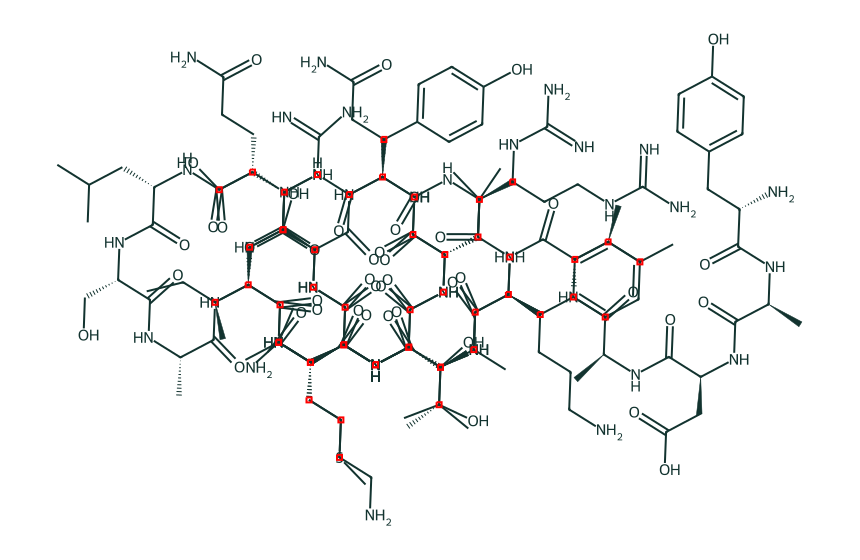
Sermorelin
Growth-hormone support peptide
Also known as Sermo, GHRH (1-29)
- Evidence grade
- CSmall or early human studies onlyScale
- Half-life
- About 11 to 12 minutes
- Schedule
- Once daily at night, subcutaneous
- Maintenance amount
- 200 mcg
- Vial sizes sold
- 5 mg, 10 mg
Where a value is not established in people, this table says so rather than filling the box.
A GHRH (1-29) analog historically used in growth hormone stimulation testing.
Sermorelin is the first 29 amino acids of GHRH, the shortest piece that still triggers growth hormone release. It prompts the pituitary to put out its own growth hormone in normal pulses, which is why it was long used as a test of pituitary function and studied in growth hormone deficiency.
Human data mainly historical pediatric use; adult anti-aging use is off-label with thin evidence.
- Historically used to diagnose and treat childhood growth hormone deficiency.
- Stimulates the pituitary to release growth hormone by acting as a GHRH fragment.
- Studied for raised IGF-1 and possible body-composition effects in adults.
- May support sleep quality in some users through GH-axis effects.
- Injection-site pain, redness and swelling are common.
- Flushing, headache and dizziness reported.
- Fluid retention and joint discomfort from GH elevation.
- Adult long-term safety and benefit are not well established.
A summary of the research, not medical advice. Individual benefits and risks vary, and for some of these compounds the human evidence is still early.
Sermorelin's human evidence is mainly historical, in diagnosing and treating childhood growth-hormone deficiency. Adult off-label reports describe better sleep within one to two weeks and slower composition changes over eight to twelve weeks, with adult long-term data limited.
Read the full timeline →Drawn from published trial data and how the research community commonly describes this stretch. Not a fixed schedule and not medical advice.
Goal of the protocol. Prompt the pituitary to release more growth hormone in a natural, pulsed rhythm.
Once daily at night, subcutaneous. For research reference only, not medical advice.
| Phase | Amount |
|---|---|
| Ongoing | 100–300 mcg at bedtime |
Commonly referenced as a steady nightly amount.
A rough shopping estimate at the maintenance amount. Your real needs shift with your dose and titration.
| Item | 8-week plan | 12-week plan | 16-week plan |
|---|---|---|---|
| Peptide vials (5 mg) | 3 | 4 | 5 |
| Insulin syringes (U-100) | 56 | 84 | 112 |
| Bacteriostatic water (10 mL) | 1 | 1 | 1 |
| Alcohol swabs (100-count box) | 1 | 1 | 2 |
Lyophilized: Keep the sealed powder cool and dark, near -20 °C where possible, dry and out of light.
Reconstituted: Refrigerate the mixed vial at 2 to 8 °C, use within a few weeks and avoid freeze and thaw.
Let a cold vial reach room temperature before you open it, so it takes on less condensation.
How strong is the evidence for Sermorelin?
We grade it C on a four-point scale. Human data is mainly historical pediatric use. Adult use is off-label with thin evidence.
What is the half-life of Sermorelin?
About 11 to 12 minutes. That is the figure the reported dosing frequency follows from.
What amount of Sermorelin is used in the research?
Ongoing: 100–300 mcg at bedtime. Commonly referenced as a steady nightly amount.
How is Sermorelin stored once reconstituted?
Refrigerate the mixed vial at 2 to 8 °C, use within a few weeks and avoid freeze and thaw.
- Prakash A, Goa KL. Sermorelin: a review of its use in the diagnosis and treatment of children with idiopathic growth hormone deficiency. BioDrugs. 1999;12:139-157.
- Thorner M, et al. Growth response to growth hormone-releasing hormone(1-29)-NH2 compared with growth hormone. J Clin Endocrinol Metab. 1993;77:1170-1173.